
Technology / Innovation
Transforming CO₂ into clean energy
Key Project Data
Coordinator
CTC
Duration
3 years (12/2024 – 11/2027)
Countries involved
5
Partners involved
1 Research Center, 3 Universities, 3 Industries, and 2 Stakeholders
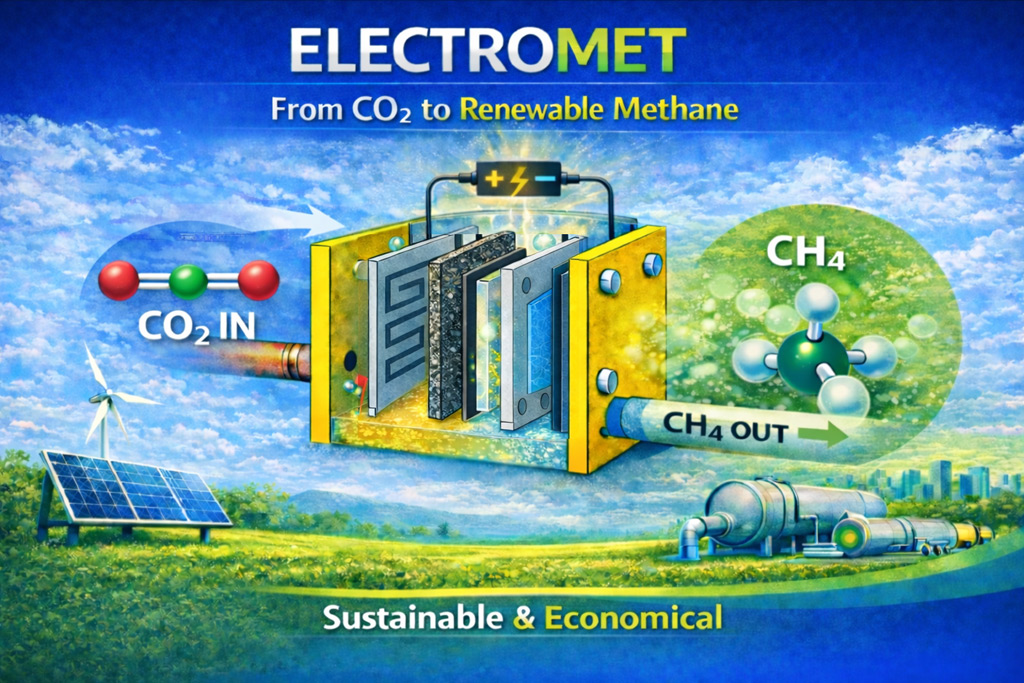
Direct CO2 ELECTROcatalysis for renewable METhane production or ELECTROMET Aims to develop a sustainable and economical method for producing renewable methane (RCH4) from carbon dioxide (CO2) via direct electroreduction, integrating it as a renewable fuel into the gas market.
The ELECTROMET project is funded by

ELECTROMET aims to demonstrate, from laboratory to industrial scale, that it is possible to efficiently convert CO₂ into renewable methane, integrate it into the gas grid, and establish a viable business model, through the development of advanced catalysts, a scalable electrolyzer, a digital twin, and a roadmap to facilitate market adoption.
RESEARCH AND TECHNOLOGY CENTER
RESEARCH CENTER — CTC
Coordinator · Spain · RTD
CTC is a non-profit foundation specialized in industry decarbonization, advanced materials and digitalization. CTC has coordinated several H2020 projects and has participated in national and international projects in the field of nanomaterials and digitalization.
Main role:
- Coordination (WP1)
- Catalyst synthesis (WP2)
- Digital Twin design and implementation (WP3, WP4)
- Reporting and knowledge management (WP6)
PARTNER UNIVERSITIES
UC — UNIVERSITY OF CANTABRIA
Spain · UNIVERSITY
UC is a public university equipped with modern infrastructure for data and IT management and general services. In particular, the DePRO research group, composed of 17 researchers and one technician, focuses on electrode preparation and the electroreduction of CO₂ into high-value chemicals.
Main role:
- Electrode design and development (WP2, WP3)
- NZCO₂ electrochemical reactor testing (WP3, WP4)
UPORTO — UNIVERSITY OF PORTO
Portugal · UNIVERSITY
UPORTO is a prestigious research university responsible for more than 20% of Portugal’s scientific publications. In particular, the LEPABE research unit focuses on catalysis, CCUS and photoelectrochemical cells.
Main role:
- Catalyst synthesis and characterization (WP2)
- Preliminary laboratory electroreduction tests (WP2)
- Catalyst provider (WP3, WP4)
Italy · UNIVERSITY
POLITO — Politecnico di Torino
Politecnico di Torino (POLITO), founded in 1906 from the roots of the Technical School for Engineers established in 1859, is one of the leading engineering universities in Europe, with a strong tradition in polytechnic education, innovation, and collaboration with industry. Within ELECTROMET, activities are carried out at the Department of Applied Science and Technology (DISAT), in the Micro and Nanostructured Materials group, which focuses on computational and experimental design of advanced catalytic materials.
Main role:
- CO₂ catalyst design, synthesis, and characterization (WP2)
- Ab initio and theoretical modelling of catalytic systems (WP2)
- Catalyst provider for reactor validation and scale-up activities (WP3, WP4)
INDUSTRIAL PARTNERS
DREVEN
Greece · NON-PROFIT SME
DREVEN is a top-ranking Greek SME innovating in the fields of environmental science and information technology. Its main areas of expertise include Circular Economy, Climate Change Resilience, and Information and Communication Technologies (ICT).
Main role:
- Validation and impact analysis of the ELECTROMET solution
- e-LCA and LCC assessment
- Business case scenarios (WP5)
ECODUALBA
Spain · SME
ECODUALBA is an SME specialized in the design and development of biogas and RCH₄ generation projects from biomass through anaerobic digestion. The company operates one of the few biogas pilot plants in Spain, which has been running 24/7 for more than two years.
Main role:
- Installation, integration and operation of the NZCO₂ pilot in the biogas pilot plant (WP4)
HIDRITEC
Spain · SME
HIDRITEC is an engineering company specialized in the implementation of innovative turnkey solutions based on compact and modular plants that are easily transportable, simple to operate and designed to minimize the consumption of consumables.
Main role:
- Development and construction of a mobile NZCO₂ pilot (WP3)
- Installation and integration in the biogas pilot plant (WP4)
STAKEHOLDERS
EnviTec Biogas
Germany · ENTERPRISE
EnviTec Biogas operates in 15 countries and covers the entire biogas production value chain. In 2018, the company reported a turnover of EUR 186.8 million and employed approximately 427 people worldwide.
Main role:
- Real biogas stream provider for NZCO₂ electrochemical reactor laboratory validation (WP3)
- Advisory Board member
Nortegas
Spain · ENTERPRISE
Nortegas is a Spanish energy group that supplies natural gas and LPG to companies and households. In 2021, the company reported a turnover of EUR 225 million and employs more than 800 direct and indirect staff.
Main role:
- Real biogas stream provider for NZCO₂ electrochemical reactor laboratory validation (WP3)
- Advisory Board member
ELECTROMET aims to demonstrate, from laboratory to industrial scale, the feasibility of efficiently converting CO₂ into renewable methane, integrating it into the gas grid with a viable business model, through the development of advanced catalysts, a scalable electrolyzer, a digital twin, and a roadmap to facilitate market uptake.
The ELECTROMET project work plan is structured into six interrelated work packages (WPs).
Management of the project’s various activities and tasks, ensuring their coordination, execution, and progress in order to guarantee that each milestone is achieved on time and with satisfactory results.
Design, analysis, and fabrication of the target CO₂ catalyst. New CO₂ catalysts are developed and validated to improve the efficiency and selectivity of CO₂ electroreduction to renewable methane. The work includes the design of at least three catalysts based on inorganic, organometallic (MOF), and non-metallic (GQD) materials, the establishment of performance indicators through ab initio modelling, and the operation of laboratory reactors (5 cm² electrodes) at 100 mA cm⁻² with >80 % faradaic efficiency.
Design, construction, and validation of an NZCO₂ electrochemical reactor under laboratory conditions. The CO₂ electrolyzer is scaled up from laboratory to pilot scale. This work integrates membrane-based gas upgrading with the electroreduction reactor and develops a modular Net Zero CO₂ pilot plant (100 cm² electrode, 2 L min⁻¹ gas flow rate).
CASE STUDY: Industrial demonstration of the NZCO₂ pilot. A digital twin is developed to model and optimize pilot deployment. The team deploys sensing devices (gas analyzer, flow meter, pH sensor) in the pilot to collect real-time data. This WP provides predictive control and decision-support tools for scaling and integration.
The pilot is validated under real biogas conditions for 100 h in the laboratory and subsequently operates for 500 h in a biogas plant to assess performance, emission reduction, and stability. This WP demonstrates the technical feasibility of the technology at industrially relevant scales.
Assessment of the impact of the ELECTROMET solution. An ex-ante life cycle assessment (LCA) and life cycle cost (LCC) analysis are carried out to evaluate the environmental impacts and economic viability of the Net Zero CO₂ plant. The socio-economic analysis also explores market acceptance and contributes to a roadmap for wider adoption.
Reporting and knowledge community. This WP addresses technical, regulatory, and social barriers, aligns the technology with EU renewable gas policies and standards, and coordinates communication and stakeholder engagement. It ensures the dissemination, exploitation, and market readiness of the project’s results.